Are you ready to grow up your business? Contact Us
Email Address: info@billingmedtech.com
Are you ready to grow up your business? Contact Us
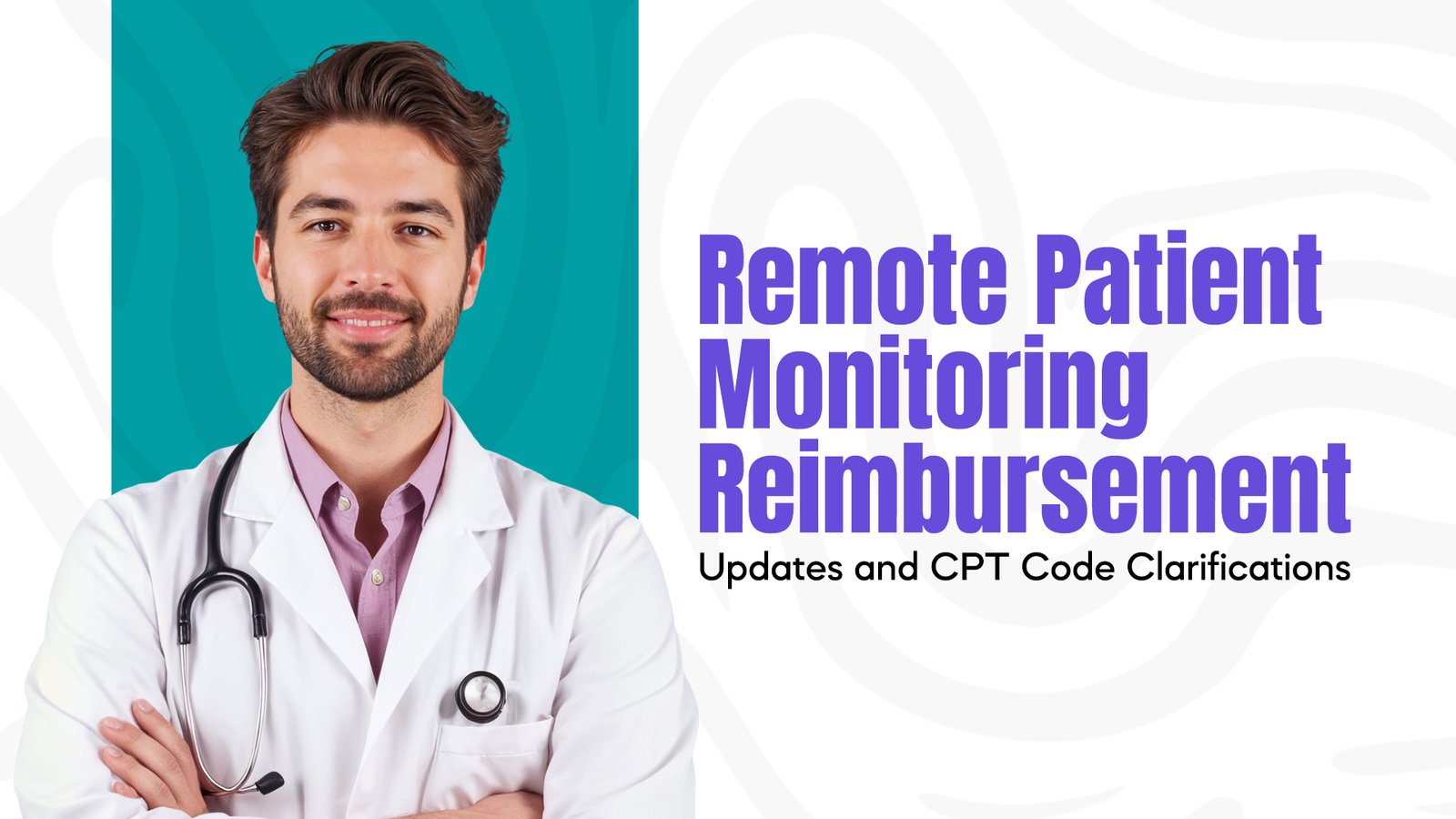


Remote Patient Monitoring is growing across practices, but many physicians are still not getting paid correctly. Claims are denied. Staff time is not captured. Documentation does not meet payer expectations. The result is lost revenue even when patient care is delivered.
For years, physicians also faced a rigid structure. If a patient used a device for fewer than 16 days, reimbursement for the supply was lost. If staff time fell short of 20 minutes, that work often went unpaid. This created a gap between clinical effort and financial return.
Remote Patient Monitoring reimbursement updates focus on improving clarity in billing rules, strengthening documentation standards, and helping physicians capture legitimate revenue without increasing audit risk.
Remote Patient Monitoring reimbursement updates refer to how payers define, track, and pay for remote care services. These updates affect CPT coding, time thresholds, supervision rules, and documentation requirements.
Revenue loss in RPM is rarely due to a lack of services. It is usually caused by gaps in billing execution.
Many practices fail to bill all components. Device setup may be completed but never billed. Supply codes may be missed if device usage is not tracked properly.
Time tracking remains one of the biggest problems. RPM is time-based. If a practice records 18 minutes instead of 20, that work does not qualify under the main management code. This creates repeated monthly revenue loss.
Communication documentation is another issue. RPM requires patient interaction for management and billing. If that interaction is not documented, the claim becomes vulnerable.
Staff roles also create confusion. Clinical staff can perform many tasks, but billing must follow supervision rules. If documentation does not clearly support supervision, reimbursement may be denied.
Under the Centers for Medicare & Medicaid Services, Remote Patient Monitoring involves collecting physiologic data from a patient outside the clinic using a qualified medical device.
The data must be collected and transmitted digitally from a medical device. Manual patient self-reporting alone does not qualify. In most cases, the device should meet the definition of a medical device as recognized by the U.S. Food and Drug Administration, meaning it is designed for medical use and capable of capturing physiologic data.
RPM is an ongoing service. It requires consistent data review, patient engagement, and clinical decision-making.
RPM services are billed using codes defined by the American Medical Association
under the Current Procedural Terminology system.
CPT 99453 covers device setup and patient education. It is typically billed once per patient for device setup, but it may be billed again if a new monitoring episode or device is initiated.
CPT 99454 covers device supply and data transmission. It requires at least 16 days of data within 30 days.
CPT 99457 covers treatment management services. It requires at least 20 minutes and documented interactive communication with the patient during the billing period.
CPT 99458 is an add-on code for each additional 20 minutes of time beyond the first 20 minutes.
CPT 99091 applies when a physician or qualified healthcare professional personally reviews and interprets patient data for at least 30 minutes. It cannot be billed concurrently with 99457 or 99458 for the same time period and cannot be delegated to clinical staff.
At this time, there are no CMS-recognized RPM codes that allow billing below the 16-day or 20-minute thresholds.
Many physicians still experience RPM as an “all or nothing” model. If a patient records 15 days of data, supply billing does not qualify. If staff time reaches 19 minutes, management billing cannot be submitted.
This is not due to missing codes. It is due to how thresholds are structured.
Practices that perform well focus on improving patient adherence and internal workflows. They use reminders, device alerts, and staff follow-up to meet required thresholds.
Instead of relying on new codes, they reduce revenue leakage by improving execution.
Recent updates focus more on enforcement than expansion.
The Medicare Physician Fee Schedule continues to define reimbursement rates, but audits are increasingly focused on documentation accuracy.
Time must be clearly recorded. General statements are not sufficient.
Supervision must be supported in documentation when clinical staff are involved.
Payers are also monitoring billing patterns. Repeated claims without strong documentation may trigger review.
The 16-day rule remains essential for CPT 99454. Without it, supply billing is not allowed.
The 20-minute rule defines eligibility for CPT 99457. Time must be cumulative and documented.
Interactive communication is required for treatment management codes, specifically CPT 99457 and 99458.
Patient consent must be documented before services begin.
Claims must be submitted correctly using forms such as CMS-1500.
Missing time logs are the most common issue. Without clear proof of time, management codes cannot be billed.
Lack of documented patient communication is another major reason for denial.
Device data must be recorded and accessible. If transmission cannot be verified, supply billing may fail.
Provider role errors also create risk. Billing under a physician without proper supervision documentation may trigger audits.
Incomplete consent documentation can also lead to compliance issues.
A primary care clinic monitored patients with hypertension using RPM devices. Data was collected consistently, but reimbursement was inconsistent.
The issue was documentation. Staff performed work but did not track the exact time. Patient interactions were not clearly recorded.
After implementing structured time logs and standardized communication notes, claims improved. Denials decreased within one billing cycle.
No new services were added. The improvement came from better documentation.
Maximizing reimbursement depends on capturing all billable work correctly.
Start by identifying every billable component. Many practices miss setup and supply codes.
Track time accurately. Use systems that log minutes as work is performed.
Train staff on documentation standards. Everyone involved should understand billing requirements.
Review claims regularly to identify patterns and correct errors early.
Avoid shortcuts. Incomplete documentation increases audit risk.
RPM can be billed alongside other services, but time must not overlap.
For example, when combined with Chronic Care Management, each service must have separate time tracking and documentation.
Payer rules may vary. Always confirm requirements before billing.
Clear separation reduces compliance risk and supports accurate reimbursement.
Remote Patient Monitoring is not limited by coding availability. It is limited by execution.
Most revenue loss comes from missed documentation, not missing services. Practices that build structured workflows, track time accurately, and document consistently see better financial outcomes.
RPM becomes profitable when it is treated as both a clinical service and a structured billing process.
Arj Fatima is a U.S. medical billing content specialist with expertise in Medicare guidelines, CPT coding, and revenue cycle management. She works closely with physician practices to reduce denials, improve compliance, and optimize reimbursement through accurate documentation and coding strategies.




Ready to optimize your revenue cycle? Our team is here to help. Contact us for a free consultation and see how Billing MedTech can make a difference for your practice.

© Billing MedTech. All Rights Reserved
In today’s fast-paced digital era, where technology continuously reshapes the future of businesses, organizations need a trusted partner who can deliver innovation with reliability. That’s where Billing MedTech comes in.
 Cardiology
 Chiropractic
 Dermatology
 Gynecology
 Home Health
 Hospital
 Mental Health
 Nephrology
 Oncology
 Ophthalmology
 Pediatrics
 Physical Therapy
 Podiatry
 Radiology
 Emergency Room
 Urgent Care
 Urology