Are you ready to grow up your business? Contact Us
Email Address: info@billingmedtech.com
Are you ready to grow up your business? Contact Us
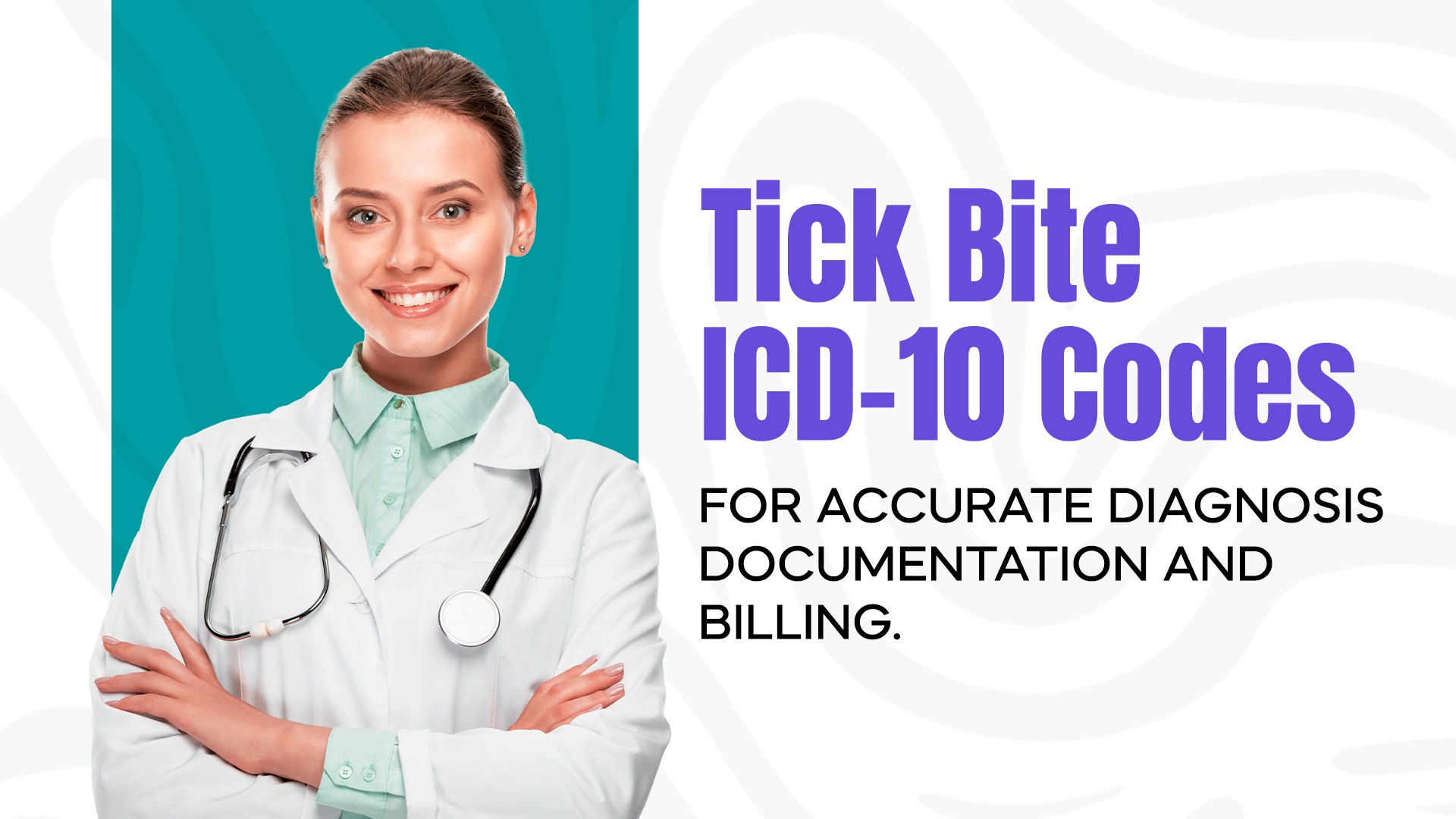


Tick bites are common encounters in primary care, urgent care, and emergency departments across the United States. While clinically straightforward in many cases, tick bite ICD-10 coding is often done incorrectly, leading to denied claims, downcoded visits, or compliance risk during audits.
This guide explains which ICD-10 codes to use for tick bites, how to document them correctly, and how to bill these encounters accurately without overcoding or missing reimbursement opportunities.
In ICD-10-CM, a tick bite is classified as an injury caused by an external agent. This means coding requires two components in most cases.
First, you must report a site-specific injury code from Chapter 19 (Injury, poisoning, and certain other consequences of external causes). These codes identify where the tick bite occurred on the body.
Second, you should assign external cause code W57, which identifies how the injury occurred specifically, contact with a nonvenomous insect or arthropod. While external cause codes are not always mandatory for payment, many payers expect them for claim completeness and audit defense.
Physicians often lose reimbursement because one of these components is missing or incorrectly sequenced.
Tick bite diagnosis coding depends entirely on accurate body-site documentation. Vague notes such as “tick bite on patient” force coders to use unspecified codes, which increases denial risk.
Common body-site groupings include:
Used when the tick bite involves the scalp, face, ear, or neck. Documentation must clearly state the exact location.
Includes shoulder, arm, forearm, wrist, hand, or fingers. Right vs left laterality must be documented.
Applies to hip, thigh, knee, lower leg, ankle, foot, or toes. Laterality and encounter type are required.
Used when the tick bite affects the chest, abdomen, back, or more than one body area.
Each site-specific code must also include the 7th character:
Missing or incorrect 7th characters are a common reason for claim rejection.
The W57 ICD-10 code identifies exposure to a nonvenomous insect or arthropod, including ticks. This code helps explain how the injury occurred and supports medical necessity.
W57 should be reported for most tick bite encounters, especially when:
The site-specific injury code is reported first, followed by W57 as a secondary code. W57 is never used alone.
W57 also requires a 7th character. Initial encounters are most common, but follow-up visits must be coded correctly to avoid inconsistencies across claims.
Documentation quality directly affects ICD-10 accuracy and reimbursement. Payers deny tick bite claims most often due to insufficient clinical detail, not incorrect code selection.
Your note should clearly document:
“Patient presents with embedded tick on right lower leg. Tick removed intact. Mild localized erythema noted. No systemic symptoms. Initial encounter.”
This level of detail supports both diagnosis coding and E/M billing.
From a billing perspective, tick bite visits often involve both evaluation and minor procedures. Correct coding ensures services are not bundled incorrectly.
An E/M service may be billed when the visit includes:
Documentation must clearly separate evaluation from the procedure.
Yes, in certain cases. Removal that requires skill or instruments may support separate billing when properly documented. Simple removal without significant work may be considered incidental.
Medicare and commercial payers closely review tick bite claims for:
Incomplete notes are the most common reason for downcoding.
Despite being a routine visit, tick bite encounters are frequently denied due to avoidable mistakes.
Common errors include:
Regular internal audits help identify these issues early.
Not every tick bite justifies coding for Lyme disease. Coding must reflect clinical certainty, not concern alone.
If Lyme disease is suspected but not confirmed, do not code the disease. Instead, document exposure and symptoms.
When Lyme disease is confirmed through testing or clinical diagnosis, it may be coded in addition to the tick bite injury, with proper sequencing based on the visit’s primary focus.
Clear documentation protects against overcoding and compliance risk.
Primary care visit: Tick embedded in left forearm, removed in office, patient asymptomatic. Code site-specific injury + W57, with E/M supported by counseling.
Emergency department visit: Tick bite with cellulitis and systemic symptoms. Code injury, infection, and external cause, with higher-level E/M justified.
Follow-up visit: Reassessment of healing without complications. Use subsequent encounter character and avoid rebilling removal.
Written by a U.S. medical billing and coding specialist with over a decade of experience supporting physician practices, hospitals, and multi-specialty groups. Expertise includes ICD-10 compliance, payer audits, and revenue cycle optimization for U.S. healthcare providers.




Ready to optimize your revenue cycle? Our team is here to help. Contact us for a free consultation and see how Billing MedTech can make a difference for your practice.

© Billing MedTech. All Rights Reserved
In today’s fast-paced digital era, where technology continuously reshapes the future of businesses, organizations need a trusted partner who can deliver innovation with reliability. That’s where Billing MedTech comes in.
 Cardiology
 Chiropractic
 Dermatology
 Gynecology
 Home Health
 Hospital
 Mental Health
 Nephrology
 Oncology
 Ophthalmology
 Pediatrics
 Physical Therapy
 Podiatry
 Radiology
 Emergency Room
 Urgent Care
 Urology